808 Drum Machine Online
The Roland TR-808 changed music forever. Now you can program 808 beats in your browser for free.
BPM
50%
3
What Is an 808 Drum Machine?
An 808 drum machine is a sixteen-sound percussion instrument built around the Roland TR-808: a boomy sustained kick, a snappy snare, a metallic cowbell, and a step grid you program them on. Online, it means all of that running in a browser tab — pads to trigger the sounds, a sequencer to place them, no hardware and nothing to install. This page is one. The original was a commercial failure. Roland built roughly 12,000 units between 1980 and 1983 and discontinued it because it did not sound like real drums. Producers bought them cheap secondhand precisely for that reason, and the machine that could not imitate a drum kit became the foundation of hip-hop, techno and pop instead. Today the 808 is the most sampled drum machine in history. Its sounds define trap, modern hip-hop, R&B, reggaeton and electronic music, and the word "808" has drifted to mean any deep sustained bass kick — often the bassline itself rather than a drum.
Loading 808 Sounds
Royalty-free. Produced in-house for crate.hiphop — 100% original, no third-party samples.
You do not need to go hunting for a kit. The 16 sounds below are the classic drum-machine layout — bass, kick, snare, clap, hats, rimshot, cowbell, toms, congas, maracas, clave, cymbal — and one click puts all of them on the pads, in that order, ready to play. No download, no zip, no dragging files. The samples are royalty-free, so anything you make with them is yours. Padwolf stays bring-your-own-sounds on top of that: drop any audio file onto a pad and it replaces whatever was there. Use this kit as the starting point and swap in your own 808s as you go.
Free 808 Generator — Make the 808 Instead of Hunting for One
Build your own 808
Six controls, no sample hunting. Tune it to the key you are working in, then send it to pad 1 and program it in the sequencer — or keep the WAV for another DAW.
Note
Decay
1.2 s
How long the note rings. Short for drill, long for trap.
Pitch drop
24 st
How far above the root the attack starts before sliding down.
Drop time
30 ms
How fast that slide lands. Fast reads as punch, slow as a dive.
Drive
35 %
How hard the tone is pushed into saturation. More grit, more presence.
Tone
8.0 kHz
Low-pass after the drive — decides how much bite survives.
Click
40 %
The transient on top, so the note reads through a busy mix.
Every 808 in every sample pack is somebody else's decision about note, length and grit. When the one you need sits a semitone off your key, you are stuck pitching a finished sample until it thins out or turns rubbery. The designer above builds the note from scratch, so it arrives in tune. Choose the root of your track, decide how long it rings, and set how hard it is driven — that alone is most of what separates a drill 808 from a trap one. Nothing gets sampled and nothing gets uploaded: the sound is synthesized in the tab you are reading this in, which is also why it is yours to use without clearing anything. When it sounds right, put it on pad 1 and it opens in Padwolf ready to sequence against the patterns further down this page. The WAV download is there too, if you would rather finish the track in another DAW.
Roland TR-808 Online — What You Actually Get Here
Search for a Roland TR-808 online and you find three different things, and it is worth knowing which one you are looking at. A circuit emulation models the original analogue voices in software. Roland's own TR-808 Software Rhythm Composer does this, and it is the only version that is actually a Roland product. A sample player loads recordings of a real 808 and triggers them — most free browser drum machines are this. And a general sampler lets you load any sound at all, 808 recordings included. Padwolf is the third kind, with the second built in. The kit above is royalty-free samples in the classic 16-sound layout, one click away, so you get the TR-808 sound palette without hunting for a pack. The generator further up synthesizes bass 808s from scratch rather than sampling them. What it is not is an emulation of Roland's circuitry or an official Roland product — nothing here is affiliated with or endorsed by Roland, and "TR-808" is their trademark. If you want the certified analogue modelling, buy theirs. If you want to program 808 beats in a browser tab for nothing, this does that.
Three 808 Patterns That Sound Nothing Alike
Slow R&B, sliding drill, dembow reggaeton. Same drum machine, completely different shapes — and in each one per-step pitch turns a single 808 row into a bassline.
Slow R&B 808 — Space Is the Loudest Element
BPM
50%
Sparse, syncopated, almost minimal. The kick lands on the '1' and the 'and-of-3'; rim-shots crack on the backbeat; eighth-note hats hold the pulse. The 808 sub only fires twice per bar — root on the downbeat, dropped a few semitones for the syncopated hit. Most of the bar is empty, which is exactly the point: the space is where the vocal lives.
Drill Sliding 808 — Pitch as a Performance
BPM
50%
4
Drill producers use rapid 808 pitch movement as a melodic device. The 808 sustain is long enough that each retune sounds like a glide. Instead of a static low end, the 808 line sings — root, drop a fifth, jump up to the b7, resolve on the b3. With per-step pitch on a single row you can sketch the whole move in seconds; no pad copies, no key tracking. The 808 loaded here actually slides. It starts a fourth above its target and glides down into it over about a third of a second — a continuous bend, not a jump between two pitches. That glide is baked into the sample, so every hit performs it. Per-step pitch then decides where each slide lands, which is the part you control. That is the split worth understanding: the bend is a property of the sound, the notes are a property of the sequence. Producers who chase this in a DAW automate pitch on the bass channel; here the sample carries the gesture and the grid carries the melody.
Reggaeton Dembow — 808 Under the Riddim
BPM
50%
The dembow rhythm — kick-and-snare locking 'boom-ch-boom-chick' across each bar — is the chassis of every reggaeton song from Daddy Yankee to Bad Bunny. The 808 walks underneath, picking up the kick hits and inserting pitch movement between them. Same row, five notes, one bassline.
Tuning the 808 to Your Key
BPM
50%
An 808 is a pitched sound — it plays a note, not just a thump — and if that note clashes with the key of the beat, the whole thing sounds off in a way listeners feel before they can name it. In trap and drill the 808 is the bassline, so it has to play the right notes. Most 808 samples are tuned to C. To move one into your key, count semitones up from C and set the pad pitch: E minor is +4, F is +5, G is +7, A is +9. Pad pitch transposes every hit equally, which puts the 808 in key but still plays one note. To make it move, set pitch per step instead — click a step, open the Step popover, set its pitch — which is how every pattern on this page walks a bassline on a single row. You don't need a tuner to hear a badly tuned 808. Play it against the root note of the beat: if the two are meant to match and sit a few cents apart, you hear one note pulsing a few times a second. That wobble is beating — the faster it goes, the further out you are, and dead in tune it stops. The player below is that test: two 808s on the same steps, one 30 cents sharp. Fix small errors with the cents control (100 cents = 1 semitone). Two things that sound like bad tuning but aren't: an 808 that glides into its note from above clashes on the attack even when the tail is right — trim the start — and low notes sound quieter than high ones at the same level, so set each pitch's volume by ear on a small speaker as well as headphones.
The Mute Group Trick
On the real TR-808, the open and closed hi-hat are physically the same cymbal — pressing the pedal closes it. So they can't sound simultaneously. Recreate this in Padwolf: put your closed and open hi-hat in the same mute group. When the closed hat triggers, it chokes the open hat's sustain — exactly like real hardware. This also works for the congas and toms: sounds in the same mute group cut each other off, creating realistic articulation.
808 Cube and Other Online 808 Beat Makers
There are a handful of browser-based 808 beat makers around — 808 Cube is one people search for by name. They differ less in sound than in what they let you keep, and there are four questions worth asking before you invest an evening in any of them. Can you load your own sounds? A tool with a fixed sound set can only ever make what its author packed in. Padwolf takes any MP3, WAV, FLAC or OGG on any of the 16 pads, so your own 808s, vocal chops and one-shots sit next to the stock kit. Can you get the audio out? This is where browser tools usually stop. Padwolf bounces to WAV, FLAC or OGG with per-step pitch baked in, so a sketch here opens as stems in FL Studio, Ableton or Logic. Can you retune individual hits? Per-step pitch on a single 808 row is what turns a drum part into a bassline — the drill and dembow patterns above are one pad each. Without it you end up copying an 808 across several pads just to get four notes. And does it need an account? Nothing on this page does. No signup, no upload, no trial: the engine is WebAssembly running in your tab, and your samples never leave the machine. We are obviously not neutral here. But those four questions are the ones that actually decide whether a free 808 maker is worth your time, whichever one you land on — so take them with you.
Frequently Asked Questions
It is free and there is nothing to download. The 808 drum machine runs in the browser tab you are reading this in — no installer, no plugin, no account, no trial. If you want the audio on your disk, you export the finished beat as WAV, FLAC or OGG.
No. Padwolf is not affiliated with or endorsed by Roland, and TR-808 is Roland's trademark. This is a browser drum machine in the classic 16-sound layout, using royalty-free samples plus a built-in synthesizer for bass 808s. Roland sells its own circuit-modelled TR-808 software if that is what you need.
The three things worth comparing are whether you can load your own samples, whether you can export the result, and whether you can retune individual 808 hits. Padwolf does all three — any audio file onto any pad, bounce to WAV/FLAC/OGG, and per-step pitch so one 808 row becomes a bassline — with no account and no upload.
You already have them — the 16-pad kit further up this page loads straight into Padwolf with one click, royalty-free, no download. If you want to go beyond it, Goldbaby, SampleFocus and r/drumkits carry authentic TR-808 samples, many recorded from real hardware, and any of them drops onto a pad the same way.
The TR-808 is the full drum machine with 16 sounds (kick, snare, hats, claps, toms, congas, cowbell, etc.). An "808 bass" specifically refers to the 808 kick drum sound — pitched low, often with a long sustain tail. In trap production, the 808 bass is both the kick and the bassline.
Yes. Padwolf is free to use. 808 samples are widely available for free. You literally need nothing but a browser and an internet connection.
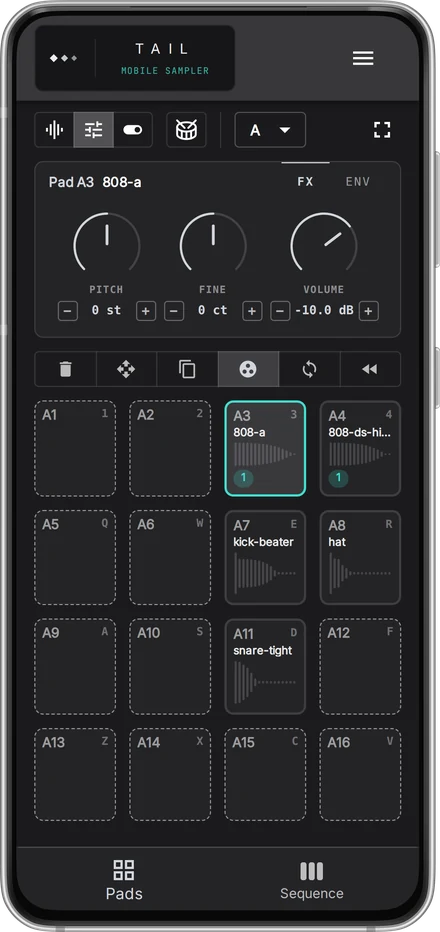
TAIL — Mobile Sampler
Want to make beats on your phone?
Sixteen pads and a step sequencer, sized for a phone.
Try it in the browser